
Fortescue adopts ABB's power conversion technology for its power network in the Pilbara, Western Australia
Published by Jody Dodgson,
Editorial Assistant
Global Mining Review,
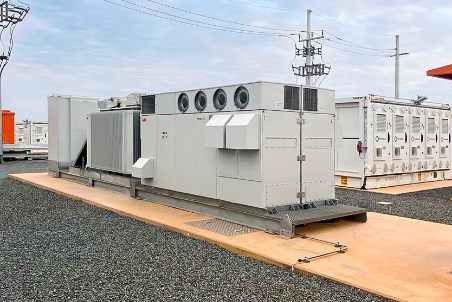
Fortescue is one of the world’s largest producers of iron ore, so when their emerging power network in the Pilbara, Western Australia required a power conversion system (PCS) to support a consistent, stable, and reliable power supply for its mining operations, Fortescue partnered with ABB.
As part of their mission to cut fossil fuels out of heavy industry processes and prove that renewable energy systems can power mining operations at scale, Fortescue developed North Star Junction – an energy hub purposely built and located close to Iron Bridge’s operations.
Understanding the challenges that large-scale producers can face with renewable energy integration and grid resilience, particularly when operations are remote, ABB successfully delivered and commissioned a 50 MW grid-forming PCS as part of a Battery Energy Storage System (BESS) for North Star Junction.
Timing for the delivery and commissioning of the ABB grid-forming BESS PCS could not have been better planned. Commissioning was done in quick time and Fortescue conducted extensive testing before placing the system into full operation, but its true value was demonstrated when an unplanned 95 MW power station outage occurred almost immediately after full start-up. The BESS responded immediately, helping maintain grid stability and prevent disruption to mining operations.
Purpose built renewable energy hub
North Star Junction includes a 100 MW solar farm, a 250 MWh/50 MW BESS, and a connection into Fortescue’s Pilbara Energy Connect transmission network. The solar farm generates renewable energy throughout the day, and the BESS stores any excess energy and delivers electricity supply when the solar generation isn’t available, ensuring continuous, stable, and reliable power onsite. This creates a more flexible and reliable energy supply while supporting Fortescue’s transition towards lower-emission mining operations.
With a planned 25-year design life, ABB supplied six integrated PCS Stations, two Orchestra Power Plant Controllers (PPCs), commissioning services and onsite training, together with grid-forming functionality.
These technologies enable the battery system to convert, control and dispatch stored energy while providing fast frequency response, voltage support and network stability to help integrate renewable energy and strengthen the resilience of Fortescue's power system. Should there be any unexpected interruption to supply, such as a loss of generation, the BESS is now equipped to deliver up to 50MW of power for five hours.
ABB technology builds a more resilient and future-ready energy network
ABB supported Fortescue by reviewing grid compliance studies and delivering a customised PCS and PPC solution designed to operate and stabilise a remote mining network. ABB commissioned the complete grid-forming power conversion system at the Pilbara site in a very short time frame with key international expertise on-site.
“Potential operating scenarios are simulated and validated before deployment, giving customers confidence that our solutions will perform as expected in real-world conditions,” said Nora Han, Senior Vice President and Global Head of Sales for ABB’s Renewable Power business. “By combining this advanced testing infrastructure with the maturity of our models, we can accelerate commissioning while giving customers greater confidence that our solutions will perform as intended throughout their operational life.”
Grid-forming technology matters today and in the future
As more remote mining operations integrate renewable energy, grid-forming technology is becoming an important enabler of the energy transition, making it increasingly important to partner with proven technology suppliers. Conventional battery systems depend on an existing electricity network to provide a stable voltage reference. Grid-forming technology, on the other hand, can autonomously establish and maintain its own stable voltage and frequency. The key advantage here is that it means sites can support network stability, provide black-start capability without requiring an external power source, and simultaneously facilitate greater integration of renewable energy into the power system.
When the grid-forming PCS operates in parallel with the existing electrical grid, they provide virtual inertia and resilience to the electrical grid.
Fortescue’s broader energy transition
The North Star Junction project represents an important milestone in Fortescue’s broader decarbonisation strategy and forms part of a planned 4 – 5 GWh rollout of large-scale battery storage systems. By combining renewable generation with grid-forming battery storage, Fortescue is taking steps towards a more flexible and resilient energy system capable of supporting mining operations while reducing reliance on fossil fuel-based generation.
For ABB, the project demonstrates how grid-forming power conversion technology can help industrial customers integrate higher levels of renewable energy while maintaining the stability, reliability, and resilience required for critical operations.
Read the article online at: https://www.globalminingreview.com/mining/07102026/fortescue-adopts-abbs-power-conversion-technology-for-its-power-network-in-the-pilbara-western-australia/