Oil price volatility refocuses mines on economics of mine haulage
Published by Will Owen,
Editor
Global Mining Review,
Tas Mohamed, CEO, Railveyor, explores how ongoing global energy uncertainty, particularly rising diesel costs, are prompting mining operations to reassess traditional haulage models – with a focus on electrified and automated alternatives that enhance cost predictability, operational resilience, and long-term efficiency.
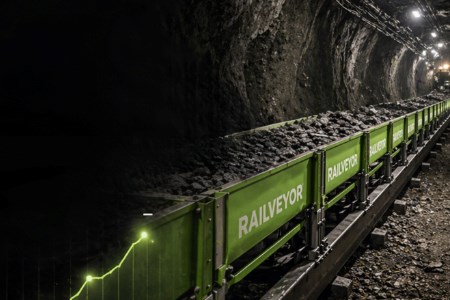
The renewed volatility in global oil markets has once again exposed the mining sector’s vulnerability to energy price shocks, highlighting the value of electrified and automated haulage options.
As the escalating geopolitical crisis in the Gulf region disrupts supply routes through the Strait of Hormuz, oil prices and diesel costs have risen sharply. For mining operations, where traditional truck haulage fleets are among the largest consumers of fuel, this translates directly into higher operating expenditure, tighter margins, and increased pressure on cost discipline. In this context, the industry is being forced to reassess diesel-based haulage models.
Electrified and infrastructure-based alternatives are gaining traction, not only as decarbonisation tools, but as strategic levers for cost reduction and long-term resilience. Indeed, these operating models fundamentally alter the cost structure of material haulage.
A recent site-based operational analysis provides a compelling quantitative case for this shift. The data demonstrates that electrified and rail-based alternatives can reduce haulage costs by over US$3/t compared to conventional truck haulage, with significant implications for mine economics.
Shifting haulage economics
At the core of this value proposition is a transition from a fleet-based system using diesel trucks to a fixed, electrified, and automated material handling infrastructure. This shift changes how costs behave over time.
A hybrid system that combines the strengths of light rail and conveyor technologies delivers not just a lower-cost way to move material – it reshapes the cost structure. It introduces greater predictability, reduces exposure to fuel price fluctuations, and removes a significant portion of the volatility that mining operations have had to absorb from oil markets.
According to the operational workbook analysis from an existing global mining installation, a system of this nature would reduce the mine’s haulage cost to between US$0.77 and US$0.84/t at this site, compared to a benchmark truck haulage cost of US$4/t.
Assuming an annual throughput of 823 000 t, this saving of over US$3/t equated to avoided-haulage costs of US$2.6 million per year. Over a three-year period, Railveyor estimated that the customer could achieve cumulative savings exceeding US$7.25 million, based on historical throughput data.
Cost categories
The analysis provided the customer with transparent cost modelling – focused on five primary cost categories – that allowed for a direct and consistent comparison with truck haulage systems. The main categories in the cost structure are labour, power consumption, equipment consumed (replacement and consumables), remote software support, and onsite technical support.
Labour represents the largest single cost component in this hybrid model, accounting for 41.9% of attributable operational expenditure. However, unlike truck haulage – where labour scales up as the fleet size grows – it decouples labour from throughput growth. With trucks, every increment of production typically requires more operators, more shifts and more supervision. The hybrid model allows an increase in throughput without proportionally increasing labour. This reduced labour intensity is a major driver of cost savings, particularly in jurisdictions and an industry where skilled operators are becoming scarce and expensive.
Efficiency through electrification
Power costs account for a relatively modest share of an electrified, infrastructure-based alternative cost base, at 9.1% of OPEX – reflecting the inherent efficiency of electrified systems compared to diesel-powered fleets. In an environment of high oil prices, this becomes a decisive advantage.
Diesel remains one of the most volatile inputs in mining – and the current global disruptions show that this can translate into business continuity risk. By electrifying their haulage, mines not only reduce energy costs but stabilise them. That predictability is incredibly valuable for long-term planning.
The use of electricity – often sourced at industrial tariffs – insulates operations from global oil price fluctuations and reduces exposure to fuel logistics challenges. In countries where grid power is generated from renewable sources, this also provides important support for mines’ decarbonisation efforts.
Lower equipment wear and consumption
The system is less demanding on equipment, resulting in lower consumption of replacement parts and consumables compared to traditional truck-based haulage systems. The components involved minimise mechanical complexity and eliminate many of the high-wear components associated with heavy vehicles – such as engines, transmissions, and tyres.
Trucks are highly complex machines operating in a harsh environment. This system is simpler, more controlled and inherently less prone to the kinds of failures that drive maintenance costs in fleets. The modelling in this study did not take into account the cost of truck rebuilds or the ventilation costs that must be incurred when diesel trucks operate underground – factors that are likely to further strengthen hybrid systems’ comparative economic position over the life of mine.
Digital optimisation
The remote software support cost category in the system’s OPEX reflects the increasing role of digital systems in modern mining operations. By leveraging remote monitoring and control to optimise performance and detect issues early, the system’s software reduces the need for onsite intervention. Finally, onsite technical support – including specialised maintenance – accounts for 13.5% of OPEX.
Conclusion
Global energy uncertainty is becoming the norm rather than the exception. The current environment risks rendering traditional haulage uneconomic in many cases, exposing mine operations to diesel price volatility and escalating operating costs. As a result, the focus is shifting toward solutions that fundamentally reset the economics of haulage – unlocking both immediate and long-term value.
Read the article online at: https://www.globalminingreview.com/mining/29042026/oil-price-volatility-refocuses-mines-on-economics-of-mine-haulage/
You might also like
The Global Mining Review Podcast
A podcast series for professionals in the mining industry featuring short, insightful interviews. Subscribe on your favourite podcast app to start listening today.