
Electric haulage technologies take the lead in mine trade-offs
Published by Jody Dodgson,
Editorial Assistant
Global Mining Review,
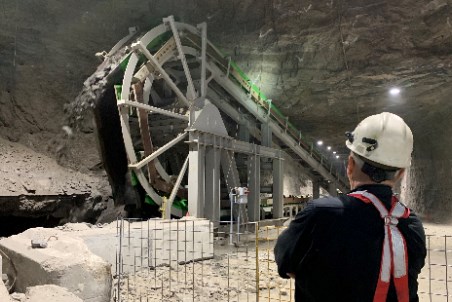
While electrified haulage technologies are rapidly gaining traction in mining as operators pursue lower-carbon operations and operational costs stability the choice between battery-electric vehicles (BEVs) and alternative electric haulage systems continues to depend heavily on mine-specific economics.
According to Tim Wiitanen, Vice-President of Product Engineering at Railveyor, the critical variables remain mine depth, production rate, and life of mine.
“These factors ultimately determine which haulage system is the most cost-effective and economically sustainable over decades of operation,” said Wiitanen. “Global mining companies are under mounting pressure to reduce emissions, with many targeting net-zero operations by 2050.”
This is accelerating interest in electrified haulage technologies. A recent GlobalData’s Development of Electric Vehicles in Surface & Underground Mining study found that, as of March 2025, 387 battery-powered mining trucks were operating globally, while 271 trolley-assist trucks were also in use across surface mining operations.
The report notes that battery-powered haul trucks remain largely at prototype stage for large-scale mining applications, although adoption is increasing steadily. Wiitanen said the industry’s decarbonisation drive is the main force behind the growing focus on electrified haulage technologies, as mining companies also seek improved economic stability through more predictable energy and maintenance profiles.
“The electrification of mines is the clear direction,” he said. “Switching from diesel trucks to electrified haulage systems is a natural progression when trying to reduce carbon footprint and creating long term economic stability.”
Trade-off studies
In this context, it is common for mines to conduct trade-off analyses between different haulage systems – comparing diesel-powered options to electric alternatives, and to assess the comparative benefits of different electric haulage systems.
"Many operators are evaluating how light rail hybrid systems such as Railveyor could support their specific operational requirements, while also trialling BEVs to assess factors such as availability, charging cycles, and battery lifespan," he said.
A trade-off study prepared by Australia-based technical services consultancy Mining Plus compared five haulage methods – diesel trucks, BEVs, conveyors, shafts and Railveyor systems – across mine depths ranging from 500 m to 1250 m and production rates from 1 Mt/y to 20 Mt/y. The study concluded that the optimal haulage system is highly dependent on depth, tonnage throughput and mine longevity.
Focusing on the difference between BEV trucks and Railveyor, Wiitanen noted that the study explored the economics of their respective infrastructure specifications, bottlenecks and operational flexibility.
Infrastructure
BEV truck fleets require charging infrastructure and operational layouts that support fleet movement, including passing bays and suitable drift dimensions. Light rail hybrid systems such as Railveyor rely on electrified rail infrastructure, drive stations, and automated controls, presenting an alternative approach to mine haul design.
Infrastructure considerations become more important as mines deepen. Longer haul distances may increase BEV truck cycle times, potentially requiring additional vehicles to maintain production targets, while also influencing traffic management and operational planning underground. Light rail hybrid systems, by comparison, can scale through the extension of track infrastructure and the addition of railcars, offering a different approach to stabilising throughput at greater depths.
“Energy infrastructure also emerges as an important consideration,” explained Wiitanen. “BEVs require charging systems that must be integrated into mine electrical networks, while light rail hybrid systems draw continuous power directly from mine supply infrastructure and can recover energy through regenerative braking.”
Wiitanen added that charging strategies and power requirements are likely to remain an important consideration for operators evaluating BEV adoption in deeper mines with steeper gradients – particularly as charging frequency and infrastructure demands evolve alongside operational requirements.
Bottlenecks
Operational bottlenecks also remain an important consideration, he pointed out. BEV truck fleets operate on cycle-based systems, where loading, travel, unloading and charging intervals all influence productivity. According to the comparison study, these factors can create congestion and queuing underground, especially as fleet size increases.
“Light rail hybrid systems, by comparison, operate continuously, with automated loading and unloading sequences reducing traffic interactions underground,” he explained.
The trade-off model also highlighted differences in labour and maintenance approaches. BEV operations typically require operators, dispatch systems and maintenance teams that scale proportionally with fleet size, while light rail hybrid systems rely more heavily on fixed infrastructure, with maintenance focussed on rails and drive stations rather than large mobile fleets.
Ventilation requirements also remain an important economic consideration underground. Both BEVs and light rail hybrid systems offer significant advantages through the elimination of diesel exhaust emissions, reducing reliance on extensive ventilation infrastructure while also lowering ventilation-related operating costs. However, the study noted that heat and particulates still require some ventilation management.
Operational flexibility
Wiitanen acknowledged that BEVs offer considerable operational flexibility, particularly in shorter-life mines or operations with evolving ore zones. The comparison study found that BEV truck fleets generally involve lower upfront capital costs and can adapt more easily to changing mine plans.
“Light rail hybrid systems are typically more infrastructure-intensive initially, but their economics strengthen over long mine lives where infrastructure costs can be amortised over a decade or two of operation,” he said.
For now, the mining sector appears likely to pursue multiple electrification pathways simultaneously, he concluded. GlobalData reported that companies including BHP, Rio Tinto, Newmont and Teck are actively piloting large-scale battery-electric haul trucks, while several operations are also simultaneously expanding trolley-assist systems. Wiitanen believes that battery technology will continue improving, while noting that long-term economics of haulage decisions will remain site-specific.
“Battery technology is going to continue advancing, creating lower-carbon opportunities especially for shorter-life mining operations,” he said. “At the same time, light rail hybrid systems like Railveyor are demonstrating compelling results in longer-life operations that plan to mine deeper and expand production.”
Read the article online at: https://www.globalminingreview.com/mining/04062026/electric-haulage-technologies-take-the-lead-in-mine-trade-offs/
You might also like

USA Rare Earth, Pasqal, and Riven Systems partner to advance next-generation technologies for critical mineral production
USA Rare Earth, a rare earth, critical minerals and advanced materials company, Pasqal, a global leader in neutral-atom quantum computing and Riven Systems, a specialist in AI for industrial chemistry, have announced a strategic partnership to develop next-generation separation technology for the rare earth value chain.