Prioritising reliability in dust suppression for MENA mining
Published by Will Owen,
Editor
Global Mining Review,
Mohamed Ghali, Komet Irrigation, explores why reliability is becoming a key consideration in dust suppression systems and how this supports safer, more efficient mining operations.
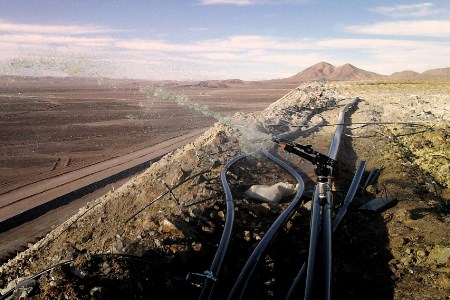
Mining activity across the Middle East and North Africa is entering a period of significant growth. Driven by economic diversification initiatives and increased investment in domestic mineral resources, countries – such as Saudi Arabia, Oman, and Egypt – are expanding their mining sectors at pace. As operations scale and new projects come online, attention is increasingly turning to a critical but often overlooked aspect of mine site performance: dust suppression.
While dust control has traditionally been viewed as a supporting operational function, its role in maintaining safe, efficient, and productive mining environments is becoming increasingly important. In the harsh operating conditions common across the MENA region, reliability is emerging as one of the most important considerations when selecting dust suppression systems.
Mining operations in the region face a unique combination of environmental challenges. Extreme temperatures, high dust loads, mineral-rich water sources, and vast operational areas place considerable strain on equipment. Under these conditions, systems that require frequent maintenance, adjustment, or replacement can quickly increase operational complexity and maintenance demands.
For mining operators, reliability is therefore about much more than equipment longevity. It is about ensuring that critical dust suppression infrastructure continues to perform consistently under demanding conditions, helping to maintain visibility, reduce airborne dust, and support uninterrupted operations.
The most effective dust suppression systems are typically built around a number of engineering fundamentals. Durable construction allows equipment to operate continuously in abrasive environments without significant mechanical degradation. Corrosion protection helps mitigate the impact of mineral-rich water sources that can accelerate wear over time. Uniform spray distribution ensures consistent dust control across operational areas, while large coverage radii reduce the number of units required and simplify overall system design.
These characteristics become increasingly important as mining operations grow in scale. Large sites require solutions that are simple to install, easy to maintain and capable of delivering dependable performance over long operational lifecycles. Systems with fewer components and connections can reduce potential failure points and minimise maintenance interventions, while high-coverage sprinklers can help reduce infrastructure requirements and labour demands.
There is also a growing focus on operational efficiency. Mining companies across the region are under increasing pressure to optimise resources, improve productivity, and maximise asset performance. Dust suppression systems that operate reliably and efficiently can support these objectives by reducing downtime, simplifying maintenance, and ensuring consistent performance across large operational areas.
As mining industries across the Middle East and North Africa continue to expand, the role of dust suppression is evolving. No longer viewed simply as an auxiliary system, it is becoming recognised as an important contributor to safe, efficient, and resilient mining operations.
In this environment, reliability is not merely a product feature. It is a strategic consideration that supports operational continuity, worker safety, and long-term performance.
Read the article online at: https://www.globalminingreview.com/handling-processing/01072026/prioritising-reliability-in-dust-suppression-for-mena-mining/
You might also like
The Global Mining Review Podcast
A podcast series for professionals in the mining industry featuring short, insightful interviews. Subscribe on your favourite podcast app to start listening today.