
Mining's New Playbook
Published by Jody Dodgson,
Editorial Assistant
Global Mining Review,
Mining has always been seen as an industry of extremes: enormous machines, remote sites, and non-stop pressure to move material faster and cheaper. But as those in the industry know too well, there is a quieter reality shaping outcomes just as much as ore grades or commodity prices – the health of the infrastructure itself. For years, the industry has accepted inspection and maintenance as a necessary headache – slow, costly, dangerous, and often based on incomplete information. The default approach has been to patch things up, replace assets early, and carry the costs as part of doing business. But that equation is breaking down. Aging infrastructure, tighter margins, and higher safety and ESG expectations mean the old playbook is no longer good enough. A new way of thinking is emerging, powered by robotics, AI, and advanced data science. It is not just a shiny technology story. It is about unlocking three clear sources of value that are already changing the way mines operate: faster and safer inspections, smarter use of capital, and the ability to finally get to the root cause of infrastructure failures. And there is a crucial ingredient running through all of it: value tracking. Mining companies do not have room for science experiments or nice-to-have pilots. They need measurable impact from day one, with the ability to hold their technology partners accountable for results.
The 3 S’s: Speed, scaffolding, and safety
If you ask any veteran miner what is wrong with traditional inspections, you will likely hear some version of the following: they take forever, they put people in harm’s way, and the results are still incomplete. This is the case because for as long as mines have existed, infrastructure inspections have been carried out the same way: people with clipboards and handheld sensors, often dangling from scaffolding or ropes, trying to take consistent readings in difficult conditions. Think of ‘Joe on a rope,’ inching along a tank wall, taking single ultrasonic thickness readings every few feet. This approach has three major flaws: It is slow. Large assets can take weeks or even months to inspect manually, often requiring downtime or scaffolding builds that themselves add cost and delay. It is dangerous. Inspectors work at height, in confined spaces, and around operating equipment. Every inspection carries risk. It is incomplete. A few hundred readings on a tank wall or pipeline section cannot capture the full picture of structural health.
This is a preview of an article that was originally published in the November/December 2025 issue of Global Mining Review. Subscribe to Global Mining Review for free to read this article in full and many more here.
Read the article online at: https://www.globalminingreview.com/special-reports/22122025/minings-new-playbook/
You might also like
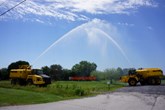
Philippi-Hagenbuch celebrates 25 years of efficient, safe dust control with its patented water tanks
Philippi-Hagenbuch Inc., a global leader in off-highway truck customisation, is commemorating the 25th anniversary of its HiVol® Water Tanks.