
A global innovation leader and driving force for agile geoscience in mining to speak at the World Mining Congress 2026 in Lima
Published by Jody Dodgson,
Editorial Assistant
Global Mining Review,
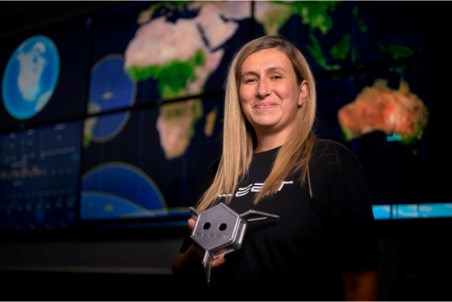
As Co-Founder and CEO of Fleet Space Technologies and a renowned aerospace engineer, she will share her expertise in satellite innovation applied to mineral exploration.
The World Mining Congress 2026, organised by the Peruvian Institute of Mining Engineers, aims to bring together leaders who are accelerating the transformation of the mining industry in response to an urgent challenge: speeding up the discovery of the minerals essential for global electrification and sustainability. Recognised for bringing space technology into the core of strategic decision-making in mining, Flavia Tata Nardini will be one of the most anticipated voices at this world-class event.
An Australian scientist and entrepreneur - profiled by outlets such as the Financial Review and Forbes - Nardini has been widely recognised for her contributions to innovation. In addition to leading Fleet Space Technologies, she holds key roles within the space and technology ecosystem: Chair of the Australian Space Agency Space Industry Leaders Forum, Mission Chair of the 7 Sisters Moon Mission, and director on the board of Austmine – the leading industry association for Australia’s mining technology sector, representing over 700 companies around the world.
ExoSphere: Revolutionising mining with agile geoscience
Under her leadership, Fleet Space Technologies developed one of the most disruptive solutions in global mineral exploration: ExoSphere, a technology that combines nanosatellites, ground-based sensors, and artificial intelligence to generate highly accurate 3D subsurface models, reducing drilling costs by up to 60% and increasing discovery rates up to 4X.
ExoSphere’s potential quickly captured the industry’s attention. Rio Tinto became its first major client, marking a turning point for Fleet Space and validating the system’s ability to deliver faster, more reliable geophysical data with a far smaller environmental footprint than conventional methods.
The use of artificial intelligence has begun to change the rules of mineral exploration by making it possible to identify areas with mineral potential without the need for extensive drilling campaigns. As Tata Nardini puts it, “it means we can find the copper of the future with less environmental impact,” she explained in an interview with the Financial Review.
Nardini emphasises that the energy transition demands unprecedented acceleration. “Quite simply, the discovery of critical minerals must increase exponentially if we are to electrify our society by 2050, and breakthroughs like ExoSphere are needed to make that happen,” she said.
Today, her solutions are being used in exploration projects across the Americas, Australia, Africa, and Europe, cementing her position as one of the most influential figures driving innovation in the global resources industry.
Nardini’s approach aligns with the spirit of the Congress – Mining for the Future: Trust, Transformation, Technology – by showing how the convergence of space technology and mining can usher in a new era of responsible and efficient discovery.
Read the article online at: https://www.globalminingreview.com/mining/07012026/a-global-innovation-leader-and-driving-force-for-agile-geoscience-in-mining-to-speak-at-the-world-mining-congress-2026-in-lima/
You might also like

Epiroc wins large order for underground mining equipment in Zambia
Epiroc AB, a leading productivity and sustainability partner for the mining and infrastructure industries, has won a large order for mining equipment from Mopani Copper Mines Plc in Zambia.