
Innovative Solutions For Surface Mining
Published by Will Owen,
Editor
Global Mining Review,
Giacomo Betti, Tesmec, Italy, introduces the company’s approach to surface mining amidst a period of technological transition for the industry.
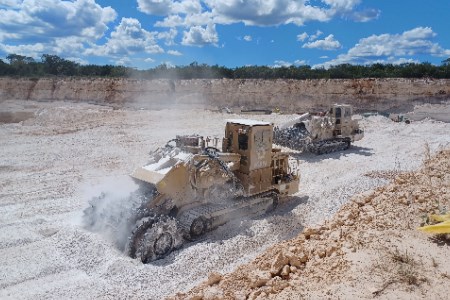
Surface mining operations are undergoing a period of significant technological transition, driven by the need for improved selectivity, predictable fragmentation, lower environmental impact and enhanced operational safety. As many deposits present increasing geological variability and regulatory frameworks become more stringent, the mining industry is prioritising excavation methods that deliver consistent results with reduced reliance on traditional drill-and-blast techniques. Continuous mechanical excavation has become a preferred approach in applications requiring precise cutting, minimal dilution, and stable material characteristics.
Advantages of continuous excavation and selectivity control
A central characteristic of Tesmec’s approach is the use of controlled, continuous surface cutting. By excavating material in thin layers, the machines allow operators to maintain accurate excavation depths and avoid the dilution that often results from blast-induced mixing of ore and waste. This level of precision is particularly important in mineral bodies where minor deviations in extraction can influence product specification, processing behaviour, or overall recovery. Controlled cutting contributes to consistent quality and improved process predictability.
Uniform fragmentation and elimination of primary crushing
The mechanical excavation process also delivers uniform, fine fragmentation directly at the mining face. Cutting drums configured with suitable tool patterns and spiral arrangements generate material that frequently meets the particle size requirements for direct haulage. Removing the crushing stage simplifies site layout, decreases equipment maintenance demands, and reduces energy consumption associated with size reduction. For operations focused on cost reduction and energy efficiency, this consolidation of excavation and fragmentation represents a significant advantage.
Mechanical efficiency through simplified transmission systems
Engineering efficiency is further supported by Tesmec’s simplified power transmission systems. The machines are designed to reduce mechanical losses by minimising the number of components between the engine and the cutting drum. This helps maintain consistent torque delivery across variable geological conditions and reduce the maintenance associated with complex mechanical linkages. As a result, the cutting systems maintain performance even in sections of heterogeneous rock strength, reducing productivity fluctuations and improving daily output predictability.
Modularity and adaptability to different geological contexts
Modularity is another distinguishing aspect of Tesmec’s surface mining range. Interchangeable cutting attachments enable the machines to adapt to different minerals and excavation requirements without substantial reconfiguration. The ability to switch between up-cutting and down-cutting modes gives operators flexibility in managing tool wear, energy expenditure, and fragmentation size. Hydraulic systems that store and release energy dynamically further improve responsiveness during excavation, especially in conditions where rock hardness varies along the mining face.
Operational safety and environmental impact reduction
Environmental and safety considerations are integrated into the overall machine architecture. Pressurised cabins shield operators from dust and noise, while climate control systems help maintain stable working conditions. Structural protections such as Roll Over Protection and Falling Object Protection are standard features designed to meet international mining safety requirements. Continuous excavation reduces the need for explosives, thereby decreasing risks associated with blast operations, such as fly-rock, air overpressure, and vibration.
Environmental benefits and reduced fuel consumption
The environmental advantages extend beyond the elimination of blasting. By consolidating excavation and primary fragmentation into a single continuous process, surface miners often require less fuel than a multi-stage system involving drilling, blasting, loading, and crushing. Lower fuel consumption translates directly into reduced emissions, supporting broader industry objectives related to decarbonisation and sustainable resource extraction. Controlled excavation also limits unnecessary disturbance of surrounding strata and reduces dust generation, improving environmental compliance.
Digital technologies for process control and optimisation
Digital technologies play a central role in the operation of Tesmec’s surface mining equipment. GPS-based systems guide machines along precise excavation paths, maintaining accurate depth and grade control. Automated steering assists in reducing alignment errors and minimising the need for rework. Electronic control platforms manage digging pressure and travel speed in real time, stabilising performance even when ground conditions vary. These features reduce reliance on operator experience, promote repeatability, and contribute to operational efficiency.
Remote monitoring and predictive maintenance
Remote monitoring systems expand these digital capabilities by collecting data on engine loads, hydraulic performance, digging distance, and other key operational metrics. The information supports predictive maintenance strategies, enabling maintenance planners to identify potential issues before they result in downtime. Automatic, as-built recording of excavation profiles enhances reconciliation between planned and actual mining and supports sites transitioning toward digitally integrated operations. In a context where equipment availability is a critical productivity driver, these digital tools offer significant value.
Dynamic Drive: Advanced cutting technology
In addition to its Rock Hawgs, Tesmec also offers its Dynamic Drive solutions, featuring an advancement in cutting transmission design. Dynamic Drive integrates a planetary gearbox directly into the cutting drum, eliminating sprockets, chains, and baseplates. This direct actuation reduces mechanical power losses, increases efficiency, and lowers wear-part expenditure. The system offers higher cutting power, higher drum RPM, and improved cutting forces, enabling enhanced productivity in materials ranging from weak to medium-strong rocks such as coal, gypsum, bauxite, phosphates, salt, potash, and marly limestone. The optimised energy transfer reduces fuel consumption per cubic metre excavated, contributing to lower CO2 emissions and improved sustainability.
Benefits for material quality management
Material quality management is an additional area where continuous surface excavation provides operational benefits. By cutting material at a controlled depth, the machines avoid mixing layers with differing geological characteristics. The resulting consistency in ore grade and particle size distribution supports efficient downstream processing and reduces the risk of contamination. In extraction environments that require strict adherence to geometallurgical models, the ability to maintain precise control over material characteristics is an important operational advantage.
Implications for mine planning and scheduling
Surface miners also support improvements in mining planning and scheduling. Without the interruptions imposed by blasting cycles, operations can adopt more continuous production flows. This improves equipment utilisation and enhances short-term production forecasting. Stable fragmentation improves the loading process and reduces wear on haul trucks, facilitating more efficient material movement and contributing to predictable daily output.
Strategic significance and future role in mining operations
Although the suitability of continuous surface mining depends on geological and economic conditions, the method provides clear advantages in deposits where selectivity, uniform fragmentation, and reduced environmental impact are priorities. Tesmec’s surface mining range demonstrates how mechanical excavation, modular adaptability, and integrated digital systems can be combined to meet the technical requirements of modern mining operations. As the industry continues to prioritise safety, sustainability, and operational efficiency, solutions such as those offered by Tesmec are positioned to play an increasingly important role in future mining strategies.
Read the article online at: https://www.globalminingreview.com/mining/03032026/innovative-solutions-for-surface-mining/