Iron ore operations in Brazil face a familiar reliability challenge: abrasive process materials, corrosion and material build-up progressively affect equipment condition. When these mechanisms are treated as isolated maintenance events, the result can be recurring shutdowns, difficult-to-predict interventions and lost availability across interconnected assets.
For operators in Brazil and elsewhere in South America, the opportunity is to manage integrity, wear and corrosion (IWC) as defined failure mechanisms throughout the asset lifecycle. This means starting with the operating problem, understanding how it develops and engineering protection around the actual service conditions.
Managing IWC as a lifecycle issue
Wear and corrosion cannot always be eliminated from mineral processing. However, their progression can be slowed and made more predictable. A lifecycle approach considers the mechanism affecting the asset, the process material, operating conditions, maintenance history, and the consequences of failure before selecting a protection system.
Testing may be required to establish how a proposed system will perform under representative conditions. Material selection is only one part of the process: surface preparation, application quality, field execution and a clear understanding of operating limits are equally important to long-term performance.
This systems-based view is particularly relevant where a recurring intervention on one item of equipment affects the availability of a wider process. The objective is not simply to protect a surface, but to reduce the operational disruption associated with predictable failure mechanisms.
Applying established coating expertise to iron ore
Coatings are one tool for managing IWC, and their effectiveness depends on matching the technology to the failure mechanism and operating environment. Iron ore is a new sector for CRC Evans, but the underlying coating capability has been developed through demanding surface-protection work in sectors including oil and gas.
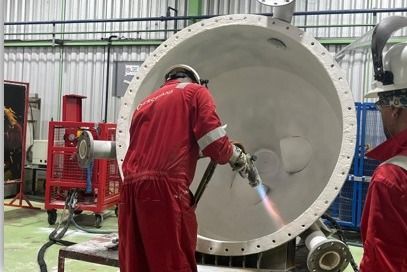
That experience includes engineered thermoplastic coating systems applied using Flame Spray techniques, together with the capability to adapt coating formulations to specific service conditions. Engineered thermoplastics can provide smooth coverage across complex metallic surfaces, while rapid solidification can support field application and repair because the material does not depend on a conventional chemical curing period.
The relevant transfer of expertise is therefore not a claim that a coating proven in one sector can be applied unchanged in another. It is the ability to assess the failure mechanism, select and validate suitable materials, prepare the surface correctly and execute the application under field conditions. The operating problem must lead; the coating follows.
A Brazilian iron ore application
This approach was applied for a Brazilian iron ore producer through one client engagement covering two equipment scopes. Each scope began with a different operational problem and required a protection system selected for its particular service conditions.
Extending the intervention interval
One item of process equipment had required a shutdown at least once every three months. Following an assessment of its service conditions, an engineered coating system was selected and applied. The protected equipment has since operated for approximately two years without intervention, substantially extending the previous maintenance interval.
Preventing build-up in briquetting mixing tanks
A second scope addressed adhesion and material build-up on the metallic surfaces of briquetting mixing tanks. Mechanical cleaning had been required about every two weeks, taking the equipment offline. Thermoplastics were selected to address the interaction between the process material and the equipment surface. After application, the mechanical cleaning associated with the previous build-up problem was no longer required, and the coating system was subsequently qualified for new briquetting equipment.
Together, these two applications within one Brazilian engagement mark CRC Evans' entry into the iron ore sector. They demonstrate how established coating knowledge can be adapted to distinct mining problems and judged against operational outcomes. Fewer cleaning and maintenance interventions can also reduce the need for manual work around process equipment, with potential safety benefits.
What the Brazilian experience means for South American operators
The Brazilian work points to a practical process that can be applied widely across South American iron ore operations. First, define the failure mechanism and its operational consequence. Second, engineer and validate protection against the actual service conditions. Third, measure success through maintenance demand, intervention frequency, equipment availability and suitability for future assets.
This is important because two assets that appear similar may experience different combinations of abrasion, corrosion, adhesion, temperature and process chemistry. A solution should not be selected solely because it has performed elsewhere; it should be assessed for fitness for service in the specific application.
From initial cost to lifecycle value
A lifecycle approach also changes how a protection system is evaluated. Selecting primarily on initial purchase price, oversimplifying the failure mechanism or operating a system outside its defined limits can undermine reliability.
Where protection extends the interval between shutdowns, removes recurring cleaning or makes asset condition more predictable, its value goes beyond the coating's initial cost. The relevant comparison includes avoided intervention, reduced downtime, more stable maintenance planning and the potential to incorporate the qualified solution into new equipment.
Longer service life may also reduce replacement waste and the consumption of materials and chemicals associated with maintenance, strengthening the potential environmental value over the asset lifecycle.
For iron ore operators in Brazil and across South America, three principles stand out:
Treat integrity, wear and corrosion as lifecycle issues rather than isolated maintenance events.
Engineer and validate protection against the actual process and operating conditions.
Judge coating performance by the operational outcome it enables.
Iron ore processing will continue to impose demanding conditions on equipment. The Brazilian example shows that established coating expertise, applied through careful assessment and field execution, can turn recurring wear and build-up problems into more manageable elements of the asset lifecycle. For South American operators, that offers a grounded route from reactive intervention towards more predictable performance.
Authored by Frank Grillo, Director at CRC Evans Brazil.