For years, advanced analytics lived in a narrow lane: powerful, but often isolated within data science or engineering teams. While this model delivered value, it also created significant bottlenecks. Questions had to be translated, prioritised, and scheduled. By the time insights arrived, operational conditions had often already shifted, diminishing their relevance.
Bringing analysis to the people who need it
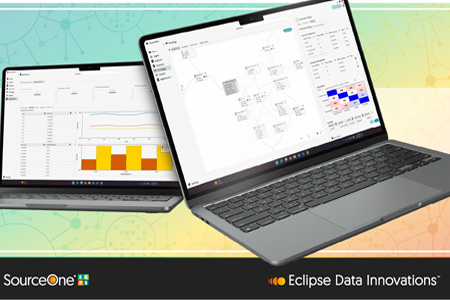
Eclipse Data Innovation flagship product, SourceOne EKPS – an advanced knowledge system that integrates and transforms raw operational data into actionable answers – is changing that. Its semantic, context-based approach, combined with a newly incorporated Machine User Interface (MUI), brings AI-driven analysis directly to operational and business users, bypassing the traditional bottlenecks between data teams and decision-makers. Backed by agentic AI that maintains context and manages complex workflows, SourceOne compresses analysis time. Advanced simulations and analytics that once took days or weeks can now be executed in minutes, enabling faster experimentation and tighter iteration cycles.
Beyond prediction: A full analytical toolkit
With the introduction of MUI in its latest product release, SourceOne translates the promise of collaborative AI into a practical, scalable tool for real-world operations. Behind the natural language interface, agentic AI systems maintain context, manage workflows, and coordinate specialised capabilities, allowing users to focus on outcomes rather than orchestration. Critically, these capabilities extend well beyond prediction. SourceOne's MUI incorporates both predictive and prescriptive analytics grounded in real operational constraints, alongside reinforcement learning for long-horizon optimisation. That combination allows organisations not only to anticipate outcomes but to evaluate trade-offs and stress-test recommended actions in real-world conditions before committing to them.
What might this look like in practice?
A process engineer notices a drop in copper recovery and suspects it may be linked to ore hardness changes in a new blast block. Using SourceOne’s MUI, they could directly access and run a previously built hybrid simulation against the last 72 hours of plant data, receiving a probably root cause and a recommended reagent adjustment before the next shift. Equally, a general manager preparing for a board review could ask SourceOne to model a range of production outcomes given current ore variability and equipment availability.
In both cases, the value is the same: the right analysis, reaching the right person, at the moment it can still influence the outcome.
Lowering the barrier to implementation
The mining industry has already experienced tangible benefits from AI-driven analytics. Early adopters of these tools are maximising asset performance, minimising downtime, and driving meaningful productivity gains. However, these outcomes have historically been hard-won. Implementations tend to be resource-intensive and must be heavily customised, slowing adoption, and limiting scalability.
SourceOne’s MUI directly addresses this challenge. By actively guiding the implementation process, including the building of the system’s ontology, which is the framework that defines how operational concepts, assets, and relationships are understood, the MUI accelerates time to value. It can surface, suggest, and validate data relationships, reducing the dependency on specialists, and allowing site teams to contribute directly to how the system understands their environment.
Importantly, the system continues to improve through use. As users interact with SourceOne, the system builds an increasingly refined picture of how the organisation actually operates. In other words, the more it is used, the more capable it becomes.
A new model for human-machine collaboration
As AI systems grow more capable, forward-thinking organisations are experimenting with outcome-focused operating structures – small teams supported by AI agents that handle forecasting, scenario analysis, and real-time reporting as a matter of course.
Tools like SourceOne’s MUI signal a broader shift in how intelligence is embedded into daily work: making advanced capabilities available to more people, while preserving the governance and oversight that enterprises require. For organisations willing to rethink how humans and machines collaborate, the payoff extends beyond efficiency. It reshapes roles, expands individual capability, and transforms AI from a specialist tool into a durable competitive asset – built not on replacement, but on partnership.
Click here to find out more information about Eclipse Data Innovation.