Gunnar Zergiebel, Dr. Mario Dilefeld, and Steffen Vollrath, TAKRAF, describe how the evolution of gearless drive conveyors over the past decades is reshaping how modern mining conveyors are designed, operated, and maintained.
While gearless drive technology has been in use in a wide range of industrial sectors, including mining, for almost six decades, it was not until the 1980s that the concept was first applied to conveyors. This relatively late adoption came despite the technology’s clear advantages, particularly for high-capacity, long-distance conveying, where high installed power, lower operating costs, improved energy efficiency and reliability, and reduced maintenance are critical.
First installed in 1986 in a coal mine in Germany, the earliest gearless drive conveyor featured a design that used a rigid connection between the drive pulley shaft and the rotor. Over the following decades, sustained development by TAKRAF Group led to an alternative option in gearless conveyor drive design. This alternative solution offers simplified installation and maintenance, improved controllability, and enhanced operational reliability. A key design evolution was the introduction of a bearing-supported rotor at the non-driven end, connected to the drive pulley shaft via a flexible membrane coupling. The group can offer both design solutions (rigid pulley–rotor connection or bearing supported rotor) based on the customer’s requirements.
TAKRAF Group’s development efforts reached a major milestone in 2019, with the commissioning of the main ore transportation system at the Chuquicamata Underground Project in Chile. The system conveys crushed copper ore from underground storage bins to the surface along a 7 km underground tunnel, where it is fed onto an overland conveyor that transports it the final 6 km to the distribution silo. Working in partnership with ABB, the group equipped the two underground conveyors and overland conveyor with 11x5 MW gearless drives, delivering up to 20 MW per conveyor.
Conveying challenges
Modern mining operations increasingly require ultra-long conveyors operating in remote and hostile environments. In such cases, gearless drives may be the only technically viable solution, particularly where conventional squirrel-cage induction motors (SCIMs) with gearboxes approach their mechanical and power limits in areas such as drive power per pulley or physical gearbox size.
The challenges are even more pronounced underground. The depth of many workings requires conveyors to lift material over long distances to reach the surface, often pushing mechanical systems to their limits. The higher drive power achievable with gearless drives also allows for longer conveyor flights, reducing the number of transfer points. This, in turn, minimises the need for underground caverns, which are expensive to construct and introduce additional technical and safety risks.
Safety, environment, and underground operation
From both an environmental and workforce safety perspective, the absence of oil-filled gearboxes significantly reduces underground fire risk by eliminating a major potential ignition source. This reduction in fire load is particularly important in confined underground environments, while the slow-speed (<100 rpm) motor operation significantly decreases noise and vibration emissions.
Underground cooling requirements can be demanding due to restricted airflow and elevated ambient temperatures. The higher efficiency of gearless drives reduces heat generation, easing cooling demands. In addition, gearless drives typically require less space than conventional SCIM-gearbox combinations, which is important where underground infrastructure space is limited.
Protection against dust and water ingress is achieved through liquid cooling systems, advanced sealing arrangements, and robust mechanical protection measures, all of which are standard features in TAKRAF designs. Externally excited synchronous motors are sealed to an ingress protection rating of at least IP54, while permanent magnet (PM) motors can achieve IP65. Removing the gearbox also eliminates the need for gearbox heating or cooling systems, simplifying operation under difficult conditions. Liquid cooling further enhances suitability for high ambient temperature environments compared with air-cooled alternatives.
Furthermore, with fewer components to manufacture, transport, and replace over the system’s lifetime, the overall environmental footprint of a gearless drive system is reduced.
Direct drive technology and efficiency
Conveyor systems are already among the most energy-efficient solutions for bulk material transport over long distances. Replacing truck haulage with conveyors significantly reduces fuel consumption and associated CO2 emissions. Gearless drives enhance this advantage further by eliminating gearbox losses, which typically account for three to four percent of total drive losses. In large-scale materials handling applications, this effect is particularly pronounced: in one mega conveyor project with a total installed drive power of over 55?MW, electric drives replaced diesel truck engines, resulting in CO2 emissions from material transport being reduced by more than two thirds for the same copper production volume.
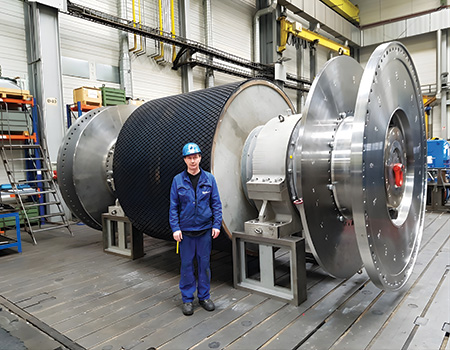
In a direct-drive configuration, the synchronous motor is coupled directly to the driven equipment. In conveyor applications, this means the drive pulley is directly connected to the motor rotor without any intermediate mechanical transmission.
Torque transmission takes place electrically via the interaction of multiple poles in the stator and rotor. To achieve the required operating speed and optimise pole count, synchronous motors are typically supplied at a lower frequency than the standard 50 or 60 Hz network frequency.
An additional advantage is the higher efficiency of synchronous motors at partial load, which is particularly relevant for conveyors that rarely operate continuously at full capacity. This characteristic leads to further reductions in energy consumption during normal operation.
Maintenance
As gearless drive systems have no gearbox, the drivetrain contains far fewer wear-prone components. In addition, the air gap between the stator and rotor means the motor operates with virtually no mechanical contact, minimising wear and eliminating the need for routine replacement of high-cost components. As a result, scheduled gearbox maintenance is completely removed.
Reduced maintenance requirements lower personnel exposure to mechanical hazards, while the absence of gear oil removes waste-oil handling requirements.
Drive system architecture
A gearless conveyor drive system comprises the drive pulley, the synchronous motor (including stator and rotor), a variable frequency drive (VFD) for controlled starting, stopping, and continuous speed regulation if required, a low-voltage excitation system for externally excited motors and the upstream power supply. Where liquid-cooled motors or VFDs are used, a closed-loop cooling system forms part of the overall configuration.
Liquid cooling makes electrical components more compact due to the higher heat density in the liquid and comes with the advantage that the heat can be transferred to the environment away from the place where it is being generated. In a closed loop configuration, no continuous process water supply is required as it works with a primary and secondary cooling circuit, decoupled by a heat exchanger.
From an electrical perspective, the gearless drive train is largely comparable to a conventional asynchronous drive up to the motor terminals, with the primary difference being the excitation circuit required for externally excited synchronous motors.
PM motors are typically favoured for drive powers up to around 2500 kW. For higher power ratings, externally excited motors are generally preferred due to their greater design flexibility and suitability for very large conveyor drives.
Operators may also consider retrofitting existing conveyors with gearless drives where installed power is up to approximately 2500 kW. In such cases, PM motors are often well suited due to their relatively low weight, compact dimensions and integrated bearing arrangements, which help maintain the required air gap. For higher power ratings using externally excited motors, however, the stiffness of existing mechanical structures may be insufficient to ensure air-gap stability under all operating conditions. Retrofitting in these cases can require substantial structural reinforcement and associated cost.
As with conventional drives, gearless drive systems are fully integrated into the digital automation platforms used in mining operations, while common protection interlocks or anomaly detection functions, along with comprehensive self-diagnostics and remote support capabilities, are standard features in modern control systems. In addition, predictive maintenance strategies can be developed from available process data or additional sensors can be added.
Mechanical integration options
In cantilevered configurations, the rotor is mounted directly onto the pulley shaft, eliminating the need for additional bearings or complex couplings. The pulley and shaft are engineered to maintain a consistent air gap between stator and rotor under all operating conditions. Shaft deflection caused by rotor mass and changing belt tensions is controlled through robust shaft and bearing design, while the stator support structure must be sufficiently rigid to prevent deformation.
Where bearing-supported motor designs are used, the rotor position relative to the stator is unaffected by pulley shaft deflection or foundation settlement under varying belt loads. These arrangements require additional components, including bearings and a coupling, which connects the pulley to the rotor while accommodating angular misalignment.
Standard geared couplings are generally suitable for smaller gearless drives. For larger systems, where misalignment exceeds the limits of geared couplings, TAKRAF Group has developed a membrane coupling capable of elastically compensating pulley shaft deflection. This design can also incorporate a brake disc flange when required.
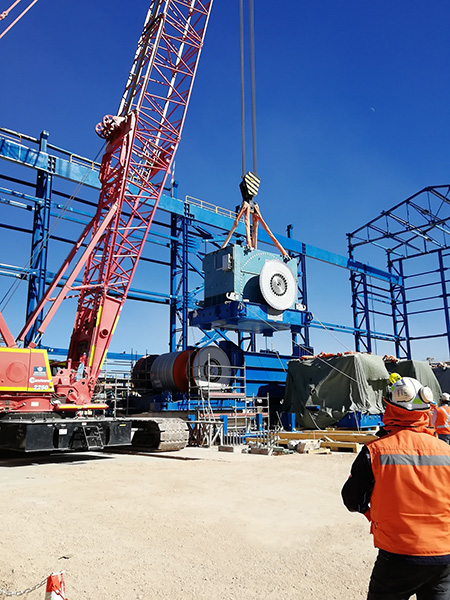
To further simplify installation, TAKRAF Group has developed a dedicated, patented gearless drive support frame. Unlike traditional cantilevered installations on concrete foundations, this frame allows the complete motor assembly to be fully assembled and tested at the factory before being shipped as a single, ready-to-install unit. Integrated adjustment features enable faster and more accurate alignment, avoiding the extensive shimming often associated with concrete foundation installations.
Future developments
Ongoing refinement is anticipated across all conveyor drive technologies, with continued focus on optimising individual design elements. A key area of development is the growing use of PM motors in conveyor applications, as although initial installations are already in service, the full capability of this technology has not been fully exploited.
While major disruptive shifts in direct drive technology are not expected in the short term, steady progress in variable frequency drives and control systems will continue. These advancements are set to further improve system reliability, operational flexibility and safety, increase energy efficiency, and contribute to reduced downtime across conveyor operations.